Read Strategy Mapping for Learning Organizations. A detailed guide to modern Balanced Scorecard thinking and techniques, their design, implementation and use. Foreword by David Norton. Learn how to develop strategy maps to capture, communicate and manage your strategy. Integrating them into your strategic balanced scorecards. Use Strategy Maps to help your organisation become more agile and responsive.
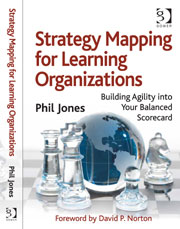
Strategy Mapping for Learning Organizations, Author Phil Jones. Published by Gower (now Routledge)
David Norton wrote the foreword for the book
From David P Norton’s Foreword:
“…the work of Phil Jones makes a unique contribution to the field of performance management.”
“This book is a ‘drivers manual’ for anyone who is implementing a Balanced Scorecard performance management system. […] it is required reading.”
David P Norton, October 2011, Author: The Balanced Scorecard. Founder and Director: Palladium Group, Inc. (David, along with Prof. Robert Kaplan, is one of the originators of the Balanced Scorecard Approach.)
Read the whole Foreword to Strategy Mapping for learning Organizations, by David P Norton
What others say about Strategy Mapping for learning organizations
“The approach in this book is so far ahead of the original balanced scorecard that I am not sure it should even have the same name.”
Alan Meekings, Founding Director, Landmark Consulting
“I have been using your book ‘Strategy Mapping for Learning Organizations’ as a guide to develop strategy maps. I must say that your book is one of the best I have used. Your book is practical, simple, with very useful tools and questions and a lot of good tips to develop the Strategy Map & Balanced Scorecard. I used your method with one of my clients and worked very well. Great job!”
Hernando Manrique, Regional Director – Chicago and Wisconsin Territories, H&R Block, Chicago, USA
“I bought Strategy Mapping for Learning Organisations as I am approaching strategy mapping and a Balanced Scorecard for our organisation. It is very useful material that I have I found to be very practical.”
Sergio Andreozzi, Strategy and Policy Manager at EGI.eu, Amsterdam, Netherlands.
“I really enjoyed reading Strategy Mapping for Learning Organizations for three reasons: firstly, its a intelligent step-by-step guide with visual strategy snapshots; secondly, Diagrams & Models – clearly outline the what’s & why’s questions on organizational agility; and thirdly, Exercises – helps ‘to get you from where you are to where you want to be’ strategically without waffle. I would definitely recommend this book to business leaders who need to react to market changes and improve agility”
Julie Williams MBB, edgeC Management Consulting
Some of the things you can learn:
- Managing the strategy conversations as either facilitator or member of the management team
- Using strategy maps to capture the latest business models and strategic thinking
- How to develop alignment and focus in a management team, that is reflected in the scorecard
- How managers think about strategy in different ways
- Why you should never start scorecard development thinking about measures
- How management teams can improve how they discuss and manage strategy
- Introducing environmental and Social impact into strategy map and scorecard design
- How you can move your organization, incrementally, towards an organisation that learns from its strategy
- The roles of left and right brain leadership in strategy map and balanced scorecard implementation
To Buy Strategy Mapping for Learning Organizations
Direct from Publisher
Selecting the cover image will take you to the publisher, Routledge’s, site.
From Amazon UK


From Amazon US


Bulk orders
Bulk orders can be made through the publisher, Routledge. Discounts are available for bulk orders.
Summary of the book, By Phil Jones,
How can we ensure our strategy will succeed, especially in changing and uncertain times? The answer, as explained in Strategy Mapping for Learning Organizations, is to become a more responsive organization. One that captures its strategy in strategy maps, learns from that strategy and can adapt to deliver results.
For anyone involved in managing strategy and performance, applying the powerful strategy mapping techniques will move your balanced scorecard from an operational tool to one of strategy and change. It will help you capture, communicate and manage your strategy more effectively.
However, strategy can no longer be simply a top down, annual process. Our process for managing strategy needs to be more iterative, emergent and involving. Many agile organizations have adopted rolling plans and budgets. To bring greater agility into the wider strategy and performance management processes requires the tools and techniques described in Strategy Mapping for Learning Organizations.
Phil Jones provides a detailed guide to developing, rolling out and managing with modern strategy maps and scorecards. His book incorporates the latest strategic thinking and models. It places the balanced scorecard in a wider governance context that includes the management of risk and environmental and social responsibility.
Fully illustrated with examples from many different organizations, this book will help you deliver your strategy better.
Contents
The book is divided into seven parts, that take you through the process of introducing, designing and using a strategic balanced scorecard and strategy maps. The foreword is by David P.Norton
- Part I Strategy and Strategy Management: The benefits and principles of strategy mapping; Managing strategy: a context of governance, strategy and learning; Capturing strategy and change in strategy maps.
- Part II The Organization’s Context: Exploring the organization’s context and value chain; Future thinking, your strategy and the tangible future.
- Part III Overall Design: Strategic themes; Designing the cascade of strategy maps.
- Part IV Detailed Design: The questions to ask when developing your strategy map; Objectives before measures.
- Part V Detailing the Perspectives: The customer perspective and customer objectives; The financial perspective and financial objectives; The environmental and social impact perspective; The process perspective and process objectives; The organizational values perspective; The external perspective.
- Part VI Alignment: Aligning programmes, projects and investment in change; Aligning budgets and the budgeting process in a learning organization; Representing and managing risk in strategy maps and balanced scorecards.
- Part VII Communication and Use: Telling the story of your strategy; Managing with your strategy map and revising your strategy map;
Want to know more about strategy maps and strategy mapping?
If you are serious about a strategy that changes performance, you have to be serious about changing behaviours: especially those deeply embedded learnt behaviours.
Strategy Mapping for Learning Organizations
Selecting the cover image will take you to the publisher, Routledge’s, site.
Strategy mapping training
Want to introduce strategy maps? Want to use them better? Want to make sure that they reflect your strategy: then give us a call. We have a variety of Strategy Map training and workshops for particular needs and sectors. Find out more Contact us
Strategy Mapping Advice & Consultancy
Do you want to make sure your strategy is delivered.
Do you want make sure your strategy is communicated, managed and delivered, using Strategy Maps, then give us a call.
To explore how we might help, simply contact us