[Note: This page exists for archiving purposes and evidence of my original copyright material. It is my original page, first published 4 July 2012, with updates through to 2017. It has been superseded by this page on the Excitant Fourth Generation Strategic Balanced Scorecard approach. The reason for this archived page is that I found on the web other people using my original copyright material from this page, verbatim, in their material. Sometimes without a proper reference, link or attribution. Also my diagrams have been re-made and re-presented as theirs, with my copyright and logo removed. Having updated the original page, I wanted an audit trail to show the original source and date from which they acquired their material from my website.
This unauthorised copying included:
- Academics using the material in their papers. Copying sentences, sections and paragraphs into their papers. I do not mind this too much. In general they do at least link to my pages. However, it is hardly good research.
- Other consultants using the material in their marketing material. In one case copying whole paragraphs to their marketing material. This I strongly object to. Hardly ethical marketing. Especially:
- Where there are no, or vague, links to my website in general, not specific sources.
- When copies are made of my diagrams, images or powerpoint slides, with the Excitant logos and copyright statements removed.
- Where there are no, or vague, links to my website in general, not specific sources.
I wanted to update the original page, so this page provides evidence of the original material and its publication date, and the date and audit trail of various revisions. If you are looking for the latest version of my material on this topic, follow this link to Excitant’s Fourth Generation Strategic Balanced Scorecard]
Managing Strategy, People and Performance, in today’s changing environment. Updating the strategic Balanced Scorecard approach for agile, learning organisations that contain human beings.
“The Excitant Fourth Generation Balanced Scorecard: A more agile, responsive, and human approach that delivers results, today.”
It is over twenty five years since Norton & Kaplan published their first article about the balanced scorecard in 1992. Since then, the Balanced Scorecard as a tool, approach and philosophy, has evolved almost beyond recognition. It has developed from that early, simplistic, measures focused control system, through to an approach that has supported strategy execution and the management of performance.
Their first approach was derived from interviewing successful executives who were looking at performance in different ways and making a difference. This was further refined and developed through hundreds of consultancy engagements conducted by Norton & Kaplan’s consultancy businesses and by examining how successful executives were applying the techniques to best effect. This changed the approach from balanced measurement, through ways to manage and drive performance, eventually becoming a powerful strategy management and execution approach. Norton & Kaplan’s Strategy Execution approach is a complete methodology, for strategy execution, alignment and management as documented in their five books, culminating in “The Execution Premium” (2008).
At Excitant we have moved on from these first, second and third generation approaches. For today’s environment we need a significant shift in how we manage our strategy, people and performance.
How has executive and management thinking changed in 20 years?
However, executive and management thinking has moved on. Around 10 years ago we started to notice significant shifts in how the executives we were working with thought and acted: how they thought about their organisations, their strategy, their people, their customers and their performance. These were not small shifts, but significant ones. They involved shifts in the underlying assumptions that underpinned how they thought and therefore acted: shifts that affected strategies, business models, customer interactions, how people in their organisations were engaged and managed. These shifts in thinking accelerated, and became more widespread, with the credit crisis of 2008, the social media revolution, with new models of business, changes to technology, economics and competition, and a need for organisations to be more aware, responsive and agile. These changes and shifts continue through to today.
At Excitant, we realised that the shifts in thinking of these successful Executives were fundamental. If they are changing the way they think about strategy, people and performance then the assumptions that underpin our approaches to managing strategy, people and performance also need to change. Over the years we have tested, refined and developed the Excitant 4G Balanced Scorecard approach by listening to successful executives and how they think: by researching current thinking that challenges how we manage , people and performance; by testing these ideas with our clients and applying what works in today’s organisations. Underpinned by how successful executives and managers think about their strategy, people and performance today (not how they thought about it 10 or even 20 years ago).
The Excitant 4th Generation Balanced Scorecard is now a sophisticated approach for systematically and continuously learning from your strategy, for socialising behavioural change, and for creating rich informed discussions about performance, within and beyond the organisation.
This is simply “Best Practice”, but “How the Best Think”
You can try to copy what others so. It is better to learn how they think differently.
Do not copy what successful organisations appear to do. This is how the “Best practice” approach. Unfortunately, like copycat strategy, copycat activities rarely succeed.
Rather learn how to think in the way successful executives and businesses think. This way you can evaluate if how they think, and act, makes sense for you.
Understanding what they believe, why they believe it and how they think about their strategy, people and performance. Much of our approach is helping executives unlearn assumptions about how they should manage and learn better ways to think about how they manage. It is the thinking that underpins the approach. For example,
- Strategy: We do not think of strategy as a deliberate annual process, but as a continuous process of learning.
- Social system: We don’t get hung up on organisational structures and silos. We think social system, bith inside and outside the organisation.
- System of Management: We don’t dictate your system of management: Rather we ask what system of management would be best for your circumstances.
- Socialising strategy: We do not talk about communicating strategy, but ask how you will socialise your strategy.
- Changing behaviours and culture: We do not discuss vague notions of ‘culture change’, but about “deeply embedded learnt behaviours”.
- Our people as decision makers: We don’t always cascade measures through organisations, but ask teams what they believe they should measure and manage themselves to achieve their objectives.
- Human Beings: We don’t talk about ’employees in an organisation’, but about ‘sensible, intelligent, responsible people in a business’.
- We don’t get ‘measure mania’ and ‘obsessive compulsive target setting’, but ensure that people understand the wider, bigger, integrated picture.
- Decision process: We focus on the right people coming together, with the right information, to have the right discussions, to make decisions, and learning from those decisions.
These few examples highlight shifts in thinking that are natural for many managers today. Their question is often, “how can I change the tools and techniques we use to better manage with this thinking”.
For others the shift is more significant: a realisation that there is a better way to manage. As one Chief Executive put it, “I realised that how I think about performance management, is at odds with how I think about our people. That has to change.”
Not “Re-inventing the wheel or “Not invented here” methodologies
We see many so called balanced scorecard enhancements out there that knock Norton & Kaplan’s work, to then suggest some alternative of their own. Usually they are completely simplifying Norton & Kaplan’s approach or making up a new approach to try and distinguish themselves in some way. Some simply re-label the approach as their own. Reading the material, many appear never to have read beyond the early material. Others pick an assumption (usually false) and dismiss it as incorrect, only to substitute one of their own. In the process they often undermining the integrity of the approach as a whole.
In contrast, our Chief Executive, Phil Jones, worked with Norton & Kaplan for over 4 years, when the approach was maturing and understands the principles on which the approach was developed. He has conducted over 50 strategic balanced scorecard engagements. In the foreword to Phil’s second book, ‘Strategy Mapping for Learning Organizations’ David Norton himself said, “Phil Jones makes a unique contribution to the field of performance management” and described the book as “…as a drivers manual for anyone implementing a balanced scorecard performance management system”.
Excitant’s Fourth Generation Balanced Scorecard Approach refines and adapts their well proven approach for today’s environment. It continues to use those aspects that are is still appropriate, useful and effective, whist refining what needs to be updated for today’s environment.
Yet, I still come across organisations struggling to get a grip on their organisations, influence behaviour, focus activity, get their staff to do the right things in the right way.
I have been lucky enough to have worked with David Norton & Bob Kaplan, and have followed their path since 1996. Over the years it has become apparent that organisations come to the Balanced Scorecard and strategic performance management with a number of different needs. These can be thought of as a progression of thinking, but is it not always the case. It is however a useful way to classify how organisations think about their challenges and how their thinking progresses.
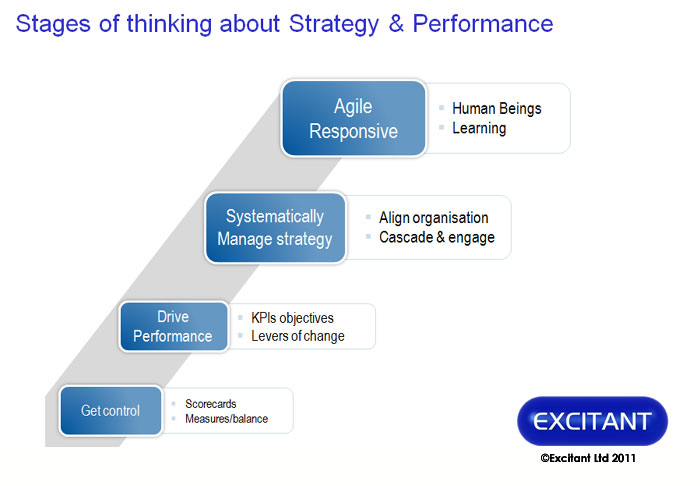
You can think of these as generations, each serving a different purpose and therefore having different approaches and benefits . In summary:

First Generation Balanced Scorecards
First generation thinking aims to solve the issue of control and “getting a grip on the organisation”. It often creates a simple collection of measures in perspectives. Such first generation scorecards are useful for operational measures, but are poor at describing the strategy and change. They are rarely balanced. They often contain very static measures, as opposed to ones that are designed to drive performance. They are useful, as an operational tool. Bob Kaplan refers to these as “operational scorecards” Frankly, as every set of measures gets called “a scorecard”, some are not even worth of the accolade “first generation”.
Second Generation Balanced Scorecards
Second generation thinking focuses on what drives performance. The focus is on the few measures, (often called KPIs) that will make a difference. There is usually some sort of cause and effect model across the perspectives. They tend also to develop objectives before measures are developed. If they include a model of performance it is usually a performance driver model. They start to reflect change in operations and they describe what drives performance. They are more selective than first generation in their choice of measures.
To get a sense of whether you are at least beyond generation one, this article explains where the second generation thinking and principles kick in. What makes a balanced scorecard balanced. It might not be what you think.
Third Generation Balanced Scorecards
Third generation thinking is about systematic, methodical implementation of strategy. These Strategic Balanced Scorecards address what Norton & Kaplan set out to address: Strategy, its management and implementation. There are various views on third generation balanced scorecards:
- Norton & Kaplan’s developments of their earlier versions which, though not generally recognised, emphasise the, articulation of strategy through the strategy map, the alignment of the organisation. the role of the Office of Strategy Management and ultimately about strategy execution.
- Cobbland and Lawrie’s Third Generation Balanced Scorecards that emphasise the Destination Statement, the problem of information asymmetry in setting objectives and targets and various implementation problems.
These two approaches have more in common than they have differences. Both contain strategy maps, cascaded through the organisation. Both set levels of ambition over time, though Cobbland and Lawrie use the Destination Statement, whereas Norton & Kaplan do not. Both generally use four perspectives (though Cobbland and Lawrie suggest dropping two for public sector organisations) . Both use strategic themes that cross the four perspectives and show the tension in the strategy. Both use objectives, before measures. Both have scorecards that reflect the measures and targets, but also the the change projects that will bring about the increase in performance. The projects can be organised into programmes of change that align with the strategic themes. They create conversation, generate understanding and help management learn from their strategy as they implement it. Both put emphasis on the management team agreeing the strategy and communicating it consistently. Both emphasise organisational alignment and communication.
Time to move on
Today we are finding clients come from a different place. Recognising they manage amidst uncertainty and risk, they want agility and responsiveness and the ability to learn as they execute their strategy. They realise that control and measures are inadequate, it is about treating people as human beings, focusing on behaviours, not simply measures and targets. They need to empower people to make decisions locally, have conversations with customers in a human voice and that the most successful executives are managing with both left and right brains. They need ways to capture and manage their new models of business and new ways of thinking about strategy more appropriate to the second decade of the 21st century.
This is “Fourth Generation” Balanced Scorecard thinking
We have been designing and implementing balanced scorecards since 1996. From these experiences we have developed a number of enhancements that build upon these earlier approaches. Enhancements that executives find intuitive and sensible. So much so that we have had projects where spontaneous balanced scorecards started to break out.
This has relied on re-thinking, turning upside down, some of the common practices and assumptions in performance management. For instance we focus on behaviours, not on measures and targets. We assume strategy is continuous. We focus on learning, not simply control. Together, these techniques are encapsulated in the Excitant Fourth Generation Balanced Scorecard approach. You can read about the techniques within this approach in “Strategy Mapping for Learning organizations”, written by our Managing Director Phil Jones, and published by Gower (2011). David Norton kindly contributed the foreword to the book, saying:
“This book is a ‘drivers manual’ for anyone who is implementing a Balanced Scorecard performance management system. […] it is required reading.”
and
“…the work of Phil Jones makes a unique contribution to the field of performance management.”
Below are some more details of the principles and underlying thinking within this approach.
Fourth Generation Balanced Scorecards start with a model of learning about the strategy as it is implemented.
They explicitly address how an organisation learns, rather than just control and management. Learning is fundamental to balanced scorecard thinking. They speed up the process of an organisation learning from its strategy. Avoiding large plans, the organisation is more amendable to change and more able to respond when changes are needed. This enables learning about the strategy and about the effect of performance.
They recognise how the organisation’s approach to governance affects strategy maps and balanced scorecard design. The organisational learning approach reinforces the need to keep the name of the fourth perspective “Learning and growth”. That is why the fourth perspective is called “Learning and growth”. If it is renamed it undermines how the organisation learns. The focus on learning fundamentally changes how these balanced scorecards are designed, introduced and used.
Fourth Generation Balanced Scorecards create the space for both leadership and management.
Leadership creates the space for your people to perform. Management is making sure it happens. The fourth generation approach explicitly describes where leadership and management play a role in performance management.
Left and Right brained leadership.
To support the leadership and management, Fourth Generation Strategy maps and Balanced scorecards have an “Organisational values” perspective. This underpins the existing four perspectives and incorporates the organisation’s values as a driver of performance and change. Organisational values are represented by a lower, fifth perspective that underpins the learning and growth perspective. We have used this approach since 1998.
Our approach invites you to both lead and manage. This is built into how our fourth generation balanced scorecards are designed implemented and operated.
Fourth Generation Balanced Scorecards address both the discipline and culture of performance. They encourage judgement and evidence.
When we manage performance we have to ensure a discipline of performance, but also create the appropriate culture of performance.
“Measure mania”, “the tyranny of targets, “silo working” and “feeding the beast” are symptoms of a poor performance management culture. Of course, you need the discipline of performance management to keep a grip on the organisation, but how do you unleash the potential of your staff to perform to their best?
The discipline of performance is about doing the basics. Evidence is needed to ensure you have the facts so you can manage: the basic information to make decisions. Having that grip without burdening the organisation, without causing more problems than benefits.
The culture of performance is about getting the best from your people. It is about creating the space for your people to perform and unleashing their potential. It is about building their judgement, helping them to understand, analyse and make decisions.
When we manage, we use judgement and evidence to make decisions
Judgement is what we pay our experienced managers for. So how do we build it? How do people learn? Our approach helps organisations develop their people,
Fourth Generation Strategic Balanced Scorecards assume that the environment is uncertain, contains risks and assumptions. They support strategy and decision making during uncertainty and change.
The future is uncertain. When we conceive of our strategy we include risks, uncertainties and assumptions. We do not conceive a single view of the future, a mythical single “destination”. Rather we conceive of a journey to potential destinations and uncertainties along the way. This is an approach that reflects how Executives actually think.
Our challenge: To manage clearly and decisively, yet be flexible and responsive, amidst risk & uncertainty.
So, we need tools designed to encourage thinking and develop conversation amongst the management team about the organisation’s future. Tools that ensure that the team are clear: where they agree; where they are uncertain; and clear where (and why) they disagree. These are built into the approach.
These tools and techniques set out the level of ambition and rate of change the organisation wishes to achieve. They help you look forward to describe the environment and the organisation at several chosen points in time. In this one respect it is like a statement of destination, but our approach goes much further. We include assumptions, uncertainties and risks. Capturing the reality that our environment, market and situation might change direction, where there are assumptions about the environment, identifies the uncertainties that need to be understood and risks to be mitigated.
Understanding where there are uncertainties, assumptions and risks amidst this ambition, means that you know what you have to continue to monitor as a team, as your strategy unfolds and is implemented.
They include an external perspective. This has two parts:
Measures and targets have a context. This context is vital to ensure that the measures and targets stay relevant as the environment changes. It also makes it much easier to compare departments, regions or countries that have the same measures but are in different situations.
Awareness: Fourth generation balanced scorecards look at the organisation’s changing context, using an External Perspective.
They use External Predicting Indicators. These External Predicting Indicators (EPIs) are used to monitor the external environment for indications that the assumptions behind the strategy has changed or that the environment has altered substantially. These are derived from the Tangible Future and Strategy map. The EPIs ensure that managers are plugged into the environment in which their strategy is being executed so that when they are reviewing the strategy with their strategy map, they are also conscious of the potential of their environment to change.
Incorporate social impact and environmental impact.
We incorporate social and environmental impact without destroying the cause and effect model across the original balanced scorecards perspectives. We recognise that these are a consequence of the organisation’s activities and behaviour.
We need to properly capture our strategy for influencing our Social, Environmental impact and responsibility
Environmental impact, is added as an external perspective alongside the financial perspective. Social impact can be added above the customer perspective. This represents the wider impact on society or the community than is represented by the customer perspective.
We retain the environmental and social impact question that the other balanced scorecards perspectives ask. What is the financial impact on the company? What do our customers want? What do we have to do well to achieve this? What do we have to learn and grow as an organisation to do this well? How do social and environmental thinking affect our organisational values. These questions embed corporate social responsibility into the strategy and the social and environmental perspectives capture the consequences.
A clear, simple, public sector and third sector model that reflects how they really work.
Many seem confused about how to use balanced scorecards and strategy maps in the public sector. We don’t understand why they are confused as it is very simple as our approach explains. We call our approach “The three ball juggle”. The public sector strategy map model understands the tensions and satisfies the three main (often conflicting) demands on public sector organisations:
The 4G Balanced Scorecard for Public sector organisations models the challenges if partnership, and the strategies needed for austerity and improved service delivery
- Serving the diverse needs of the public, community and partners,
- Whilst satisfying the demands of regulators, politicians, governance and fund holders,
- Yet doing this economically, within the financial and funding constraints.
Many public sector and third sector strategy maps lose the underlying cause and effect model. Ours does not lose this important component. We have a clear simple and logical model that preserves the cause and effect model, so you can describe strategy and show what drives performance. It works for any public sector or third sector organisation. We call it the three ball juggle. You will find it in the various public sector balanced scorecard case studies and examples.
Well developed techniques
These techniques are well developed. We have been using some since 1998 whilst others are more recent. Every client we work with will fit on this ladder somewhere. Most of our clients use our fourth generation balanced scorecard with some aspects of fourth generation (though occasionally they need help getting past generations one and two first). If they can only reach some aspects of fourth generation at the moment, we leave them legacy, and aspiration, to reach the other aspects when they are ready.
The best way to understand these developments is to have us explain them to you. To discuss arranging a briefing for you and your team at your own premises, simply contact us.